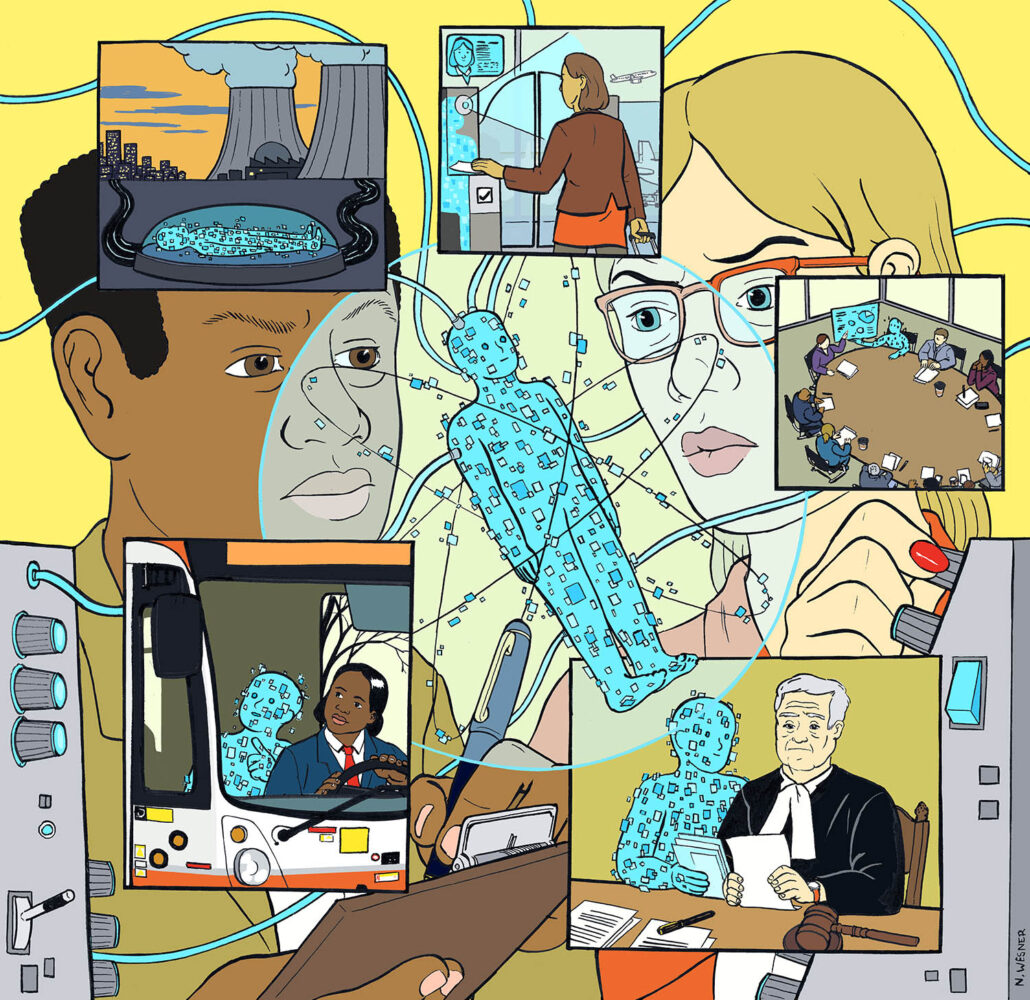
Illustration showing interconnected scenes of AI's impact: data centre cooling towers, a person at a transit interface, diverse faces overlaid with data streams, a TTC bus, someone working on a laptop, a boardroom meeting and a judge in court – all connected by flowing blue lines representing data and technology.
TMU law professor Jake Effoduh is teaching students to critically examine AI's real-world impacts on privacy, equity and justice—preparing future lawyers to navigate technology's role in the legal system. Illustration by Niklas Wesner

Research

How TMU’s Jake Effoduh prepares law students for AI’s real impacts

Through TTC transit projects and field trips to water-stressed communities, he teaches future lawyers how technology affects equity and justice

By David Silverberg

Illustration showing interconnected scenes of AI's impact: data centre cooling towers, a person at a transit interface, diverse faces overlaid with data streams, a TTC bus, someone working on a laptop, a boardroom meeting and a judge in court – all connected by flowing blue lines representing data and technology.
TMU law professor Jake Effoduh is teaching students to critically examine AI's real-world impacts on privacy, equity and justice—preparing future lawyers to navigate technology's role in the legal system. Illustration by Niklas Wesner

When students started using ChatGPT non-stop over the past two years, Jake Effoduh was one of the few professors at the Lincoln Alexander School of Law who supported their hard lean into large language models (LLMs), saying, “Sure, go ahead and play with it, figure it out!”

He goes on to say, “It’s not about telling students if they should use AI or not. It's about equipping students to know what it is, and to decide when and how to use it.”

Effoduh’s course, Data Science Law (also known as Critical Approaches to Data, Algorithms, and Science in the Law), is all about how AI is changing our lives and jobs.

He believes in empowering his students to find new solutions to everyday issues.

Real-world effects of AI

In fact, he gets them out of the classroom to see the real-world effects of AI and the prompts they use, like how they're influencing the environment.

Later this year, he plans to take his students on a field trip to an Ontario community where water levels have receded due to the data centres’ heavy consumption of water to cool its servers.

“AI is reshaping our rights, our standards of equity and justice, and I want to equip future lawyers with techno-legal literacy, so that, beyond the speed and efficiency of using tech, they can also use it to advance justice,” Effoduh said.
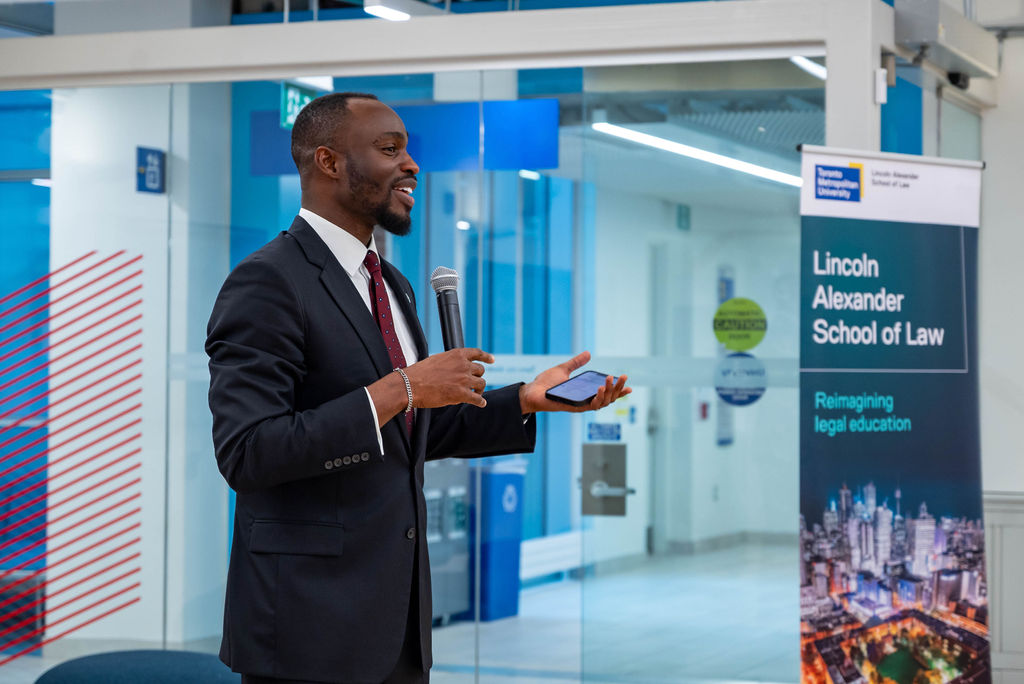
Jake Effoduh standing with a mic, giving a talk.

Jake Effoduh, a professor at TMU's Lincoln Alexander School of Law, teaches students to approach AI critically. He’s examining its technical capabilities, but also its real-world impacts on privacy, equity and justice. (Photo courtesy of Kristy Adeyemi)

The ABCs of AI and the TTC

AI is a big and sometimes confusing idea. To help people understand it better, you need to show them how it works in real life. And this is what Effoduh is trying to do with his students.

He’s passionate about giving students problems with which to use AI, demonstrated in a project he coordinated with the TTC last year.

Fare evasion has long been an issue for the transit service, which inspired Effoduh to ask his students how they could apply their knowledge of AI to ensure people paid when they boarded a bus or subway. 

“One of my students reimagined how the TTC could use geospatial and transport data to improve equity in transit planning,” he recalls, “and we showed this as one way that the TTC could integrate anonymized mobility and census data to capture gaps that serve low-income riders in the GTA. This was during the Demo Day in the course where we invited TTC, Presto and even Metrolinx staff to check out what students are coming up with.”

He adds, “I want them to be creative early in their careers because they need to do that as lawyers.”

Drawn to TMU’s focus on social justice

Growing up and educated in Abuja, Nigeria, Effoduh remembers being distracted as a child. 

“I loved new, shiny things, I loved colours,” he says, laughing, “so who knows, maybe that’s where I picked up my inclination towards technology?”

After he finished his law degree and got his master’s from the University of Oxford, Effoduh focused on Canada. 

He earned another master’s at York University’s Osgoode Hall, and advanced to do the PhD program. 

That’s when he learned about an opportunity at TMU. 

“I heard about TMU’s Lincoln Alexander School of Law and how it has a focus on social justice through a technology lens, and I knew it was for me,” he said.

He wants his students to look beyond the code and understand how laws and data privacy affect AI.

Race must be key component of AI policy

He emphasizes that the cultural consequences of AI are inseparable from its entanglement with race.

This past summer, he convened Black Futures by Design: Advancing Racial Justice in Canada’s AI Regulation, a conference that placed Black scholarship, activism and community knowledge at the centre of AI policy deliberation. 

The gathering sought to not only confront how algorithmic systems reproduce systemic inequities, but also to carve out space for Black voices in Canada to shape a more just and democratic AI future.

He says, “What I’m trying to advocate here is that if people are going to develop technology that is used by people of various racial backgrounds, they need to engage with those stakeholders early in the creation process.” 

“It’s my hope that students will take these lessons and apply them in future real-life situations, calling attention to the consequences AI can have and help those unfairly impacted by it.”   

Related stories:

David Silverberg
David Silverberg, Journalism '02, is a freelance journalist, editor and writing coach whose work has appeared in The Washington Post, BBC News, The Toronto Star, The Globe & Mail and more.

Love the digital mag?

Sign up now. Don’t miss an issue of Toronto Met University Magazine.